2015 USAMO · Question 2
Problem outline
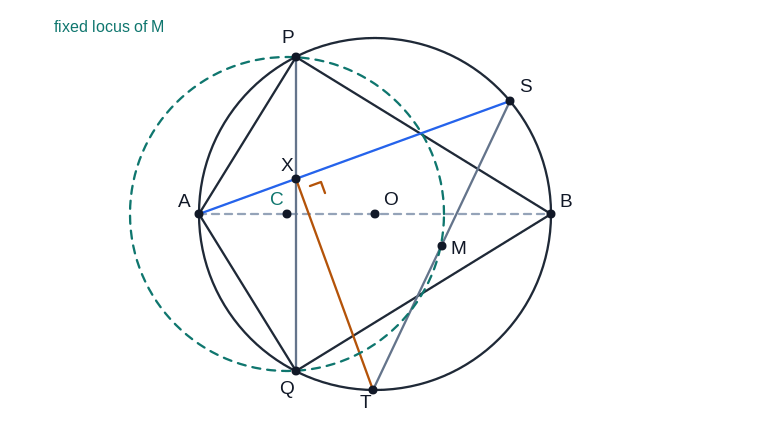
A cyclic quadrilateral satisfies and . A point varies on . The line meets the circumcircle again at , and is the point on arc for which . If is the midpoint of , prove that lies on a fixed circle.
Show answer and methods 1 methods
Answer
Let and be the center and radius of the original circle. The fixed circle has center the midpoint of and radius .
Method 1 Track the nine-point center of triangle AST
Let and be the center and radius of the given circle, and let be the nine-point center of triangle . Because all lie on the given circle, that triangle has circumcenter and circumradius .
The point is the foot of the altitude from to , since are collinear and . If is the midpoint of , then , and the midpoint of all lie on the nine-point circle of triangle . Its center is and its radius is .
Along line , the power of with respect to the nine-point circle is . In the original circle, intersecting chords give . Also , so if is the midpoint of , then and . Hence .
Therefore , so is constant. Thus moves on a circle centered at .
In vector form the centroid of triangle satisfies , while , so . The Euler-line relation gives . Combining them yields . This is a fixed translation: the circle traced by is translated to a circle of the same radius centered at .
Source and attribution
The outline and worked methods on this page were prepared for DR.WANG Mathematics.
Original question (external)