2014 USAMO · Question 5
Problem outline
Start with a triangle and its orthocenter . Draw the circle through . The internal angle bisector at meets this circle again at . Construct the circumcenter of and the orthocenter of . Show that has the same length as a radius of the circumcircle of . For the original exam, the first page of a geometry solution had to include a large, accurately scaled, labeled diagram drawn with instruments. Omitting any of these requirements cost one point.
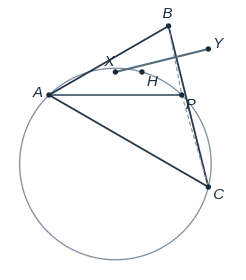
Show answer and methods 1 methods
Answer
If is the circumcenter of , then .
Method 1 Construct a distance-preserving map sending A to X and O to Y
Let and be the circumcenters of and , respectively. Rotate the plane by about the midpoint of , sending to . Then and . The altitudes and therefore give and . Both and lie on the circle with diameter . So the half-turn takes circle to circle , which is exactly circle . In particular it takes to .
Put and use the angle bisector as the horizontal axis. Write and . Both and are equidistant from and , so both have first coordinate . Write . The midpoint of is the midpoint of (equivalently, the half-turn sends to ), hence the first coordinate of is .
Consider the map . It reflects in and then translates by , so it preserves lengths and right angles. It sends to and to . The perpendicular bisector of contains both and . Reflection in the angle bisector takes the direction of to that of , and translation preserves directions. Thus the image of this perpendicular bisector is the line through perpendicular to . In particular lies on that altitude of .
Also has the same first coordinate as . It lies on the vertical line through , the altitude perpendicular to . The two altitudes meet at , so . The image of is consequently , and is the required circumradius.
Source and attribution
The outline and worked methods on this page were prepared for DR.WANG Mathematics.
Original question (external)