2013 USAMO · Question 6
Problem outline
In triangle , choose on side so both circles and are defined. Each of their two common external tangents meets line ; denote the intersections by . Determine every for which .
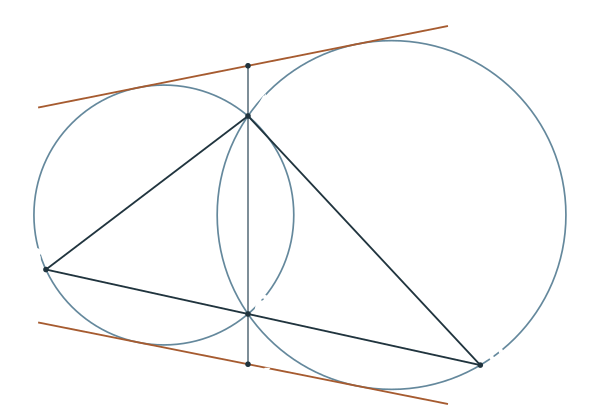
Show answer and methods 1 methods
Answer
The two division ratios are and . If , the midpoint is the sole solution.
Method 1 Use the common tangents to compare two lengths
Write , , , , and let be the perpendicular distance from to the line . Write for the centres of the circles on and for their radii. Since , the extended sine rule gives and .
Both centres lie on the perpendicular bisector of . Their perpendicular projections onto are the midpoints of and , spaced apart. The absolute projection factor onto for a direction perpendicular to is . It follows that .
Fix one common external tangent, with contact points in this order of circles. Projecting along and perpendicular to the tangent gives . This is positive since . In particular the tangent meets the radical axis : along the tangent the two powers are the squared distances to , and these are equal precisely at the midpoint of . Call this midpoint .
Let be the midpoint of . Reflection about fixes both circles, swaps the two common external tangents and sends to . It also swaps and , so is the midpoint of on the same line. Power of in either circle is . Since and , this reads . The argument includes the case of parallel common tangents when .
Consequently . Put . The cosine rule gives , and the area formula gives . Thus the fraction after the is . Inverting yields , independent of .
Now write , so . The requested equation says . Its two roots, allowing a repeated root, are and . Both are strictly between and , and all previous identities hold for every interior , so both work. By the angle-bisector theorem one is the foot on of the internal bisector at ; the other is its reflection in the midpoint of . When they coincide.
Source and attribution
The outline and worked methods on this page were prepared for DR.WANG Mathematics.
Original question (external)