2015 USAJMO · Question 5
Problem outline
Let be a convex cyclic quadrilateral. Prove that there is a point on satisfying and if and only if there is a point on satisfying and .
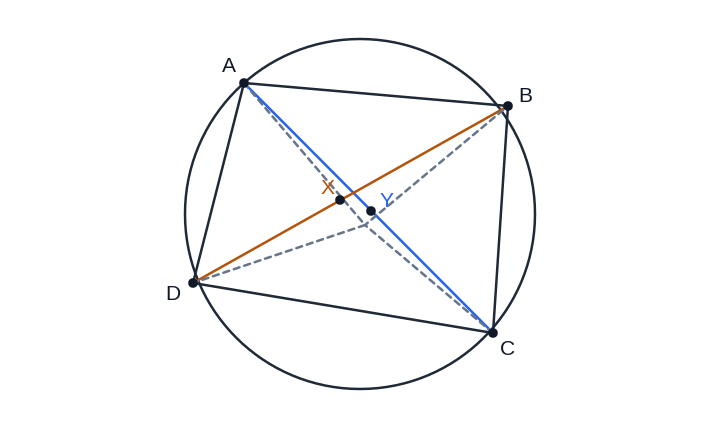
Show answer and methods 1 methods
Answer
Each of the two existence statements is equivalent to ; hence they are equivalent to one another.
Method 1 Convert each pair of angle conditions into the same side-product identity
For a point on , an area comparison in triangle gives . The requested angle at makes this .
The same area comparison in triangle gives . Thus the two rays meet the same point of exactly when these two ratios are equal.
All four vertices lie on one circle of radius . Therefore , , , and . The equality of the two ratios reduces precisely to . This proves that the point exists exactly under that identity.
Now construct the two prescribed rays for on . Comparing areas in triangles and gives, respectively, and .
Using the same circle, replace the four sines by . Equality of the two ratios is again equivalent to . Hence exists exactly when exists, proving both directions.
Source and attribution
The outline and worked methods on this page were prepared for DR.WANG Mathematics.
Original question (external)