2014 USAJMO · Question 6
Problem outline
Triangle has incenter , incircle and circumcircle . Mark the side midpoints on , on , and on . The incircle touches at and at . The line cuts the full lines and at and , respectively. On , let bisect the arc from to that contains . (a) Show that belongs to the ray starting at and passing through . (b) Show that the midpoint of belongs to line .
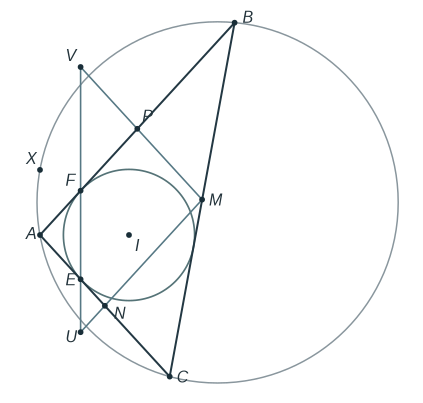
Show answer and methods 1 methods
Answer
lies between and . If is the midpoint of and , then as position vectors, so lies on .
Method 1 Use the angle bisector as a coordinate axis
Set , , , and . Equal tangents drawn to the incircle from each vertex give . Use as origin and the unit vectors along as an oblique basis. In this basis , , and has equation . The midlines and have equations and , respectively. Hence and .
The triangles have the same altitude (the inradius) to their respective sides, so their areas are in the ratio . These are the barycentric weights of , giving in our basis. Since , we have . The triangle inequality implies . This locates on segment and proves (a).
For (b), keep the origin and take perpendicular axes with the positive horizontal axis along and above it. Put , , . Our two unit basis vectors now have Cartesian components and , so oblique coordinates become . Taking the average of and gives their midpoint in Cartesian coordinates. Right triangle gives .
Let be the midpoint of the other arc. Equal arcs and give , so lies on . The two arc midpoints are the ends of the diameter on the perpendicular bisector of . If , the right angle puts on the vertical axis; when it is on this axis too. Write . Equating its squared distances to and gives , hence .
Compare coordinates: . As , this says , exactly the required collinearity. The computation never divides by and thus includes , when .
Source and attribution
The outline and worked methods on this page were prepared for DR.WANG Mathematics.
Original question (external)