2014 USAJMO · Question 2
Problem outline
An acute triangle has a angle at and is not equilateral. Let be its circumcenter and its orthocenter. (a) Prove that the line through meets the side segments and . Call its intersections on and on . (b) If is the area of and the area of the quadrilateral with boundary ––––, find exactly which values can take.
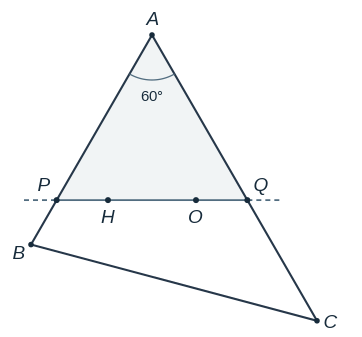
Show answer and methods 2 methods
Answer
(a) The two intersections lie strictly inside their respective sides, with . (b) The range is the open interval .
Method 1 Put the angle bisector on a coordinate axis
Write and . With at the origin, let the positive horizontal axis bisect angle and let be above it. Unit vectors along are and , so , , and . The angles at are acute precisely when and : for example , and interchanging gives the other condition.
Equal distances and give and , treating point coordinates as vectors. The altitude from gives , and that from gives . The two dot products simply switch. Adding each pair gives the same horizontal coordinate for . Subtracting gives vertical coordinates and . Since would make the triangle equilateral, the centers are distinct and is the vertical line through them.
A point at distance along either side ray has horizontal coordinate . It is on exactly when . This distance is positive and less than each of by the two acute-angle inequalities. Thus exist in the interiors of the segments, establishing (a).
Let be the fraction of the whole triangle cut off at . Using the included angle in both area formulas gives . By swapping if needed we may set , and acuteness is then . Conversely every is possible by choosing , and included angle .
Now is continuous and strictly increasing for because its derivative is . Its limiting values at are . The requested ratio is , which increases continuously from to . Neither endpoint is attained, and every intermediate value occurs.
Method 2 Reflect the perpendicular bisectors into altitudes
Let . Reflection in the internal bisector of angle exchanges its two sides. The perpendicular bisector of reflects to the perpendicular to at distance from along . This point is the foot from , because . Thus that reflected line is the altitude from . Likewise the perpendicular bisector of reflects to the altitude from . The reflection of their intersection is therefore .
Let be the midpoint of . The projections of on the directed line have distances from : the first is the midpoint of , and the second is the projection of . These distances differ, since ; hence and is perpendicular to the angle bisector at . Projection preserves midpoints, so the projection of has distance from . Consequently belongs to the internal bisector ray and .
A perpendicular to the bisector at cuts both side rays at an equal distance from . Since , we get . The triangle is acute precisely when and , since the projections of on and on then fall within the sides. These inequalities give , proving (a).
For (b) set . The above inequalities and are equivalent to , and any such value works by taking . Using and the common included angle, . Thus increases continuously from to as increases through its open interval. This gives exactly the requested range.
Source and attribution
The outline and worked methods on this page were prepared for DR.WANG Mathematics.
Original question (external)