DR.WANG Mathematics中文

2013 USAJMO · Question 5

Geometry · cyclic quadrilateral

Problem outline

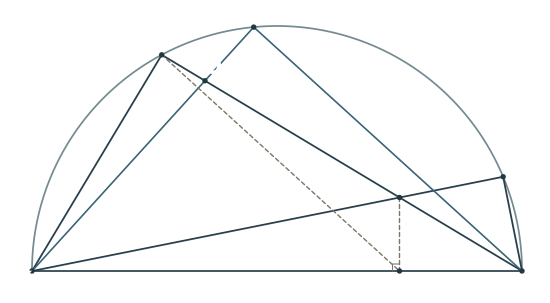
On a semicircle with diameter XYXY the boundary points have arc order X,A,B,YX,A,B,Y. Segments AYAY and BXBX cross at PP, and ZZ is the perpendicular projection of PP onto XYXY. Choose CC on the semicircle so that XC⊥AZXC\perp AZ, and put Q=AY∩XCQ=AY\cap XC. Prove BY/XP+CY/XQ=AY/AXBY/XP+CY/XQ=AY/AX.

The semicircle has diameter XY. AY meets XB at P and XC at Q; Z is directly below P on the diameter.
Show answer and methods 2 methods

Answer

The two ratios add to AY/AXAY/AX.

Method 1 Use the slopes of the two rays from X

Use X=(0,0),Y=(1,0)X=(0,0),Y=(1,0) with the semicircle above the horizontal axis. Write AYAY as y=t(1−x)y=t(1-x), t>0t>0, and let uu be the slope of XBXB. The equation of the semicircle is x2+y2=xx^2+y^2=x. Intersecting it with AYAY gives A=(t2/(1+t2),t/(1+t2))A=(t^2/(1+t^2),t/(1+t^2)). Also Z=(t/(t+u),0)Z=(t/(t+u),0) by intersecting y=uxy=ux with AYAY and dropping vertically.

Let vv be the slope of XCXC. Perpendicularity to AZAZ gives v=(Zx−Ax)/Ay=(1−tu)/(t+u)v=(Z_x-A_x)/A_y=(1-tu)/(t+u), hence t(u+v)=1−uvt(u+v)=1-uv. The specified arc order gives 0<u<1/t0<u<1/t, so both slopes u,vu,v are positive.

For either slope w=uw=u or vv, let its ray cut the semicircle at KK and AYAY at HH. The intersection coordinates are K=(1,w)/(1+w2)K=(1,w)/(1+w^2) and H=t(1,w)/(t+w)H=t(1,w)/(t+w). Therefore KY=w/1+w2KY=w/\sqrt{1+w^2} and XH=t1+w2/(t+w)XH=t\sqrt{1+w^2}/(t+w), whence KY/XH=w(t+w)/(t(1+w2))KY/XH=w(t+w)/(t(1+w^2)).

From t=(1−uv)/(u+v)t=(1-uv)/(u+v) follows t+u=(1+u2)/(u+v)t+u=(1+u^2)/(u+v) and t+v=(1+v2)/(u+v)t+v=(1+v^2)/(u+v). Substitution makes the ratios for B,PB,P and C,QC,Q equal to u/(t(u+v))u/(t(u+v)) and v/(t(u+v))v/(t(u+v)). Their sum is 1/t1/t, which equals AY/AXAY/AX by the coordinates of AA.

Method 2 Split a cosine difference

Normalise XY=1XY=1 and put α=∠AYX\alpha=\angle AYX, β=∠BXY\beta=\angle BXY. Since the ray XBXB lies closer to XYXY than XAXA, we have α+β<90∘\alpha+\beta<90^\circ. Also AX⊥APAX\perp AP and XZ⊥ZPXZ\perp ZP, so A,X,Z,PA,X,Z,P lie on the circle with diameter XPXP.

The angles ∠AZX\angle AZX and ∠APX\angle APX subtend the same chord AXAX and are equal (both P,ZP,Z lie on the same side of AXAX). Now ∠APX=α+β\angle APX=\alpha+\beta by triangle XPYXPY and the extension of YPYP. Since XC⊥AZXC\perp AZ, the acute angle γ=∠CXY\gamma=\angle CXY is 90∘−α−β90^\circ-\alpha-\beta.

The right triangles with hypotenuse XYXY give BY=sin⁡βBY=\sin\beta, CY=sin⁡γ=cos⁡(α+β)CY=\sin\gamma=\cos(\alpha+\beta), AY=cos⁡αAY=\cos\alpha and AX=sin⁡αAX=\sin\alpha. The sine rule in XPYXPY gives XP=sin⁡α/sin⁡(α+β)XP=\sin\alpha/\sin(\alpha+\beta); in XQYXQY it gives XQ=sin⁡α/sin⁡(α+γ)=sin⁡α/cos⁡βXQ=\sin\alpha/\sin(\alpha+\gamma)=\sin\alpha/\cos\beta.

After multiplying the desired sum by sin⁡α\sin\alpha, its left side becomes sin⁡βsin⁡(α+β)+cos⁡βcos⁡(α+β)=cos⁡α\sin\beta\sin(\alpha+\beta)+\cos\beta\cos(\alpha+\beta)=\cos\alpha. This is also sin⁡α⋅AY/AX\sin\alpha\cdot AY/AX, proving the result.

Source and attribution

The outline and worked methods on this page were prepared for DR.WANG Mathematics.

Original question (external)