1962 IMO · Question 3
Problem outline
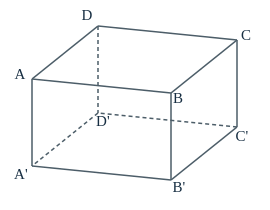
On a cube, upper vertices lie directly above . Point repeatedly walks around , while repeatedly walks around . Start them together at and with equal constant speeds. Find and draw the path traced by the midpoint of .
Show answer and methods 1 methods
Answer
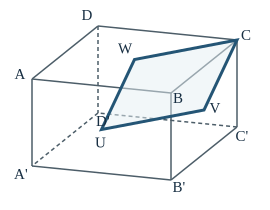
The four sides of a rhombus. In traversal order its vertices are the midpoint of , the midpoint of , the vertex , and the midpoint of .
Method 1 Connect simultaneous midpoints
Use a unit cube with , , and . Primed vertices have the same first two coordinates and height zero. The moving points reach successive corners at the same instants.
Averaging their positions gives the midpoint sequence , , , and back to . On each leg both positions depend affinely on the same time parameter, so the midpoint traces the entire segment between successive positions.
The four successive displacements are , , , . The vectors have the same length and are not parallel, hence the path is exactly the boundary of the rhombus shown.
Source and attribution
The outline and worked methods on this page were prepared for DR.WANG Mathematics.
Original question (external)