BMO2 · 2025/26 · 2026-01-21 · Question 2
Problem outline
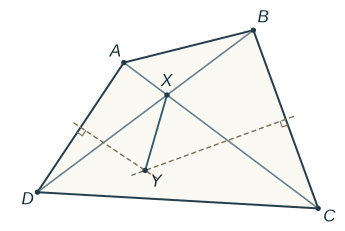
Let be the intersection of the diagonals of a convex quadrilateral . Sides and are not parallel. Their perpendicular bisectors meet at a point strictly inside triangle . Prove that exactly when bisects .
Show answer and methods 1 methods
Answer
Both conditions are equivalent to .
Method 1 Project onto the two diagonal rays
Put at the origin and let be unit vectors towards . Write , , , with positive lengths. For the position vector of , set , . The equal distances and give, after squaring, and .
Since is strictly inside the angle, its two projections agree exactly when it lies on the internal bisector: is equivalent to equality of the cosines of the angles that makes with the two rays. If , the equations give . This says , or .
Conversely, suppose . The pair solves the two equations. Their determinant is , which cannot vanish: if it did, the coefficient pairs and would be proportional, so the vectors and along and would be parallel. The solution is unique, so the actual projections agree and is the internal bisector.
Source and attribution
The outline and worked methods on this page were prepared for DR.WANG Mathematics.
Original question (external)