BMO1 · 2026/27 · 2026-11-18 · Question 3
Problem outline
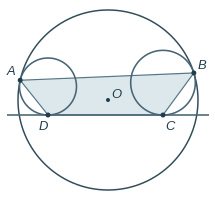
Two disjoint circles inside touch it at respectively. They lie on the same side of a common tangent line, which touches them at respectively. The centre of is inside . Prove that lie on one circle.
Show answer and methods 1 methods
Answer
The four points are concyclic.
Method 1 Use parallel diameters and a secant product
Place the common tangent horizontally with the small circles above it. Let and be the bottom and top endpoints of the vertical diameter of . The homothety centred at that shrinks to the first small circle sends its lowest point to the lowest point . Hence are collinear, with between and . Similarly are collinear.
Let be the distance from to the common tangent. If the ray makes angle with the upward vertical, then . A chord from in that direction has length by the right-angle theorem on the diameter (also valid for the diameter itself). Thus .
The same calculation gives . The circle through meets the ray again at the unique point satisfying this product, namely . Thus it contains all four points.
Source and attribution
The outline and worked methods on this page were prepared for DR.WANG Mathematics.
Original question (external)