BMO1 · 2025/26 · 2025-11-19 · Question 6
Problem outline
On a cycle of 1000 pads, positions each start with one frog and the others are empty. A frog may move four pads in either direction into an empty pad. It may instead move three pads into an empty pad if the two intervening pads each hold a frog, removing both of those frogs. Exactly one move is made at a time. For which can a single frog remain?
Show answer and methods 1 methods
Answer
Precisely or .
Method 1 Combine four parity classes with a local reduction
Partition the pads by their residues modulo 4, which remain consistent across the wrap because . A four-step move preserves all four class counts. A three-step jump changes each class count by one in absolute value, flipping all four parities. A successful play from needs exactly jumps, so must be odd.
Each complete block of eight initial frogs contributes two to each class. For residues , the initial numbers of odd classes are respectively . The required jump counts have parities even, odd, even, odd respectively. Thus the final numbers of odd classes are . One frog has exactly one odd class, excluding residues 5 and 7.
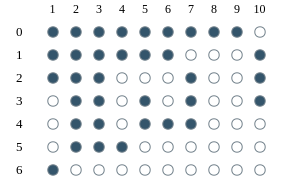
It remains to construct the moves. In a local segment numbered 1 to 10, start with 1 through 9 occupied and 10 empty. Make the moves , , , , , . The first two and last two are jumps removing two frogs apiece. The middle two are four-step moves. Only pad 1 remains occupied in the segment.
Apply this pattern to the last nine frogs in the initial block and the next empty pad. This shortens the contiguous block by eight without affecting anything before it. Valid are at most 995, so the first empty pad always exists for this construction. Repeat until one or three frogs remain. From three, jump the first over the other two to the empty fourth pad.
Source and attribution
The outline and worked methods on this page were prepared for DR.WANG Mathematics.
Original question (external)