2026 AMC 8 · Question 25
Problem outline
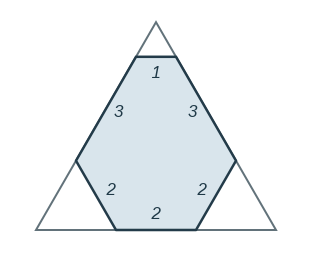
An equiangular hexagon sits inside an equilateral triangle, with all six vertices on its boundary. An example cuts off the three triangle corners with hexagon edges of lengths 1, 2 and 2; on one triangle side the hexagon edge between the cuts of lengths 1 and 2 is 3. In this same triangle count all such hexagons having six positive integer sides, identifying rotations and reflections.
Show answer and methods 1 methods
Answer
E. .
Method 1 Parametrize by the three corner cuts
A interior angle cannot fit at a triangle corner. A straight side of the triangle cannot contain three hexagon vertices. Thus two vertices lie on each side; the three discarded corners are equilateral triangles since their angles are . The example determines the triangle side as .
Let the corner cuts have side lengths . The three remaining hexagon sides are . Positivity is equivalent to . If , then and ; if , then and . Larger cannot occur. This gives eight triples.
All triples are realizable by cutting the corners. To verify that they count distinct hexagons, put . The perimeter is . For triples of equal , the alternate side-length triples of a hexagon are and . A rotation or reflection can only preserve these sets or interchange them. Interchange between different triples of the same sum would require , in which case the two sets already coincide.
Source and attribution
The outline and worked methods on this page were prepared for DR.WANG Mathematics.
Original question (external)