2024 AMC 12B · Question 19
Problem outline
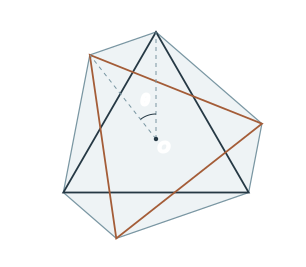
Rotate an equilateral triangle of side 14 about its centre so that move to , respectively. The rotation angle is . Around the outside the six vertices form the hexagon , of area . Determine .
Show answer and methods 1 methods
Answer
B. .
Method 1 Add the six triangles at the centre
Topics usedArea using sineTrigonometric identities
The common circumradius of the two triangles is . The angles subtended at the centre by the hexagon sides alternate between and . All are below , so six centre-to-side triangles cover the hexagon exactly.
Their area sum is . Comparing with the given area yields . The angle is acute, so its sine is .
Write . The subtraction formula gives ; inserting gives .
Source and attribution
The outline and worked methods on this page were prepared for DR.WANG Mathematics.
Original question (external)