2024 AMC 12A · Question 18
Problem outline
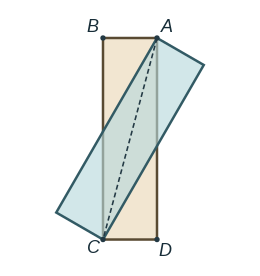
Stand a rectangular card with its long sides vertical, width , and height . Its upper-left, upper-right, lower-left and lower-right corners are , respectively. Place an identical card by rotating clockwise about the card centre by the smallest positive angle that sends diagonal onto . Add successive copies by the same rotation each time, so consecutive cards share one diagonal. Counting the original card, when does a corner of an added card first coincide with ? (A) (B) (C) (D) (E) No later card reaches .
Show answer and methods 1 methods
Answer
A. The sixth card.
Method 1 Track the directions of the diameters
All copies have the same centre and the same diagonal length. Thus a corner coincides with exactly when one of its diagonal lines coincides with . If is the angle of a diagonal with a long side, then . Hence .
Start counting directions at , clockwise and modulo because the diagonals are unoriented lines. The diagonals of card one have directions and : the latter is . The two diagonals of card therefore have directions and .
For cards two through five, neither value is a multiple of . On card six the second value is , so that diagonal has the original endpoints .
Source and attribution
The outline and worked methods on this page were prepared for DR.WANG Mathematics.
Original question (external)