2022 AIME II · Question 15
Problem outline
Two externally tangent circles have centers separated by . A further circle through both centers meets the first circle at and the second at . The six points occur around that circle as the convex hexagon . Given and , find its area.
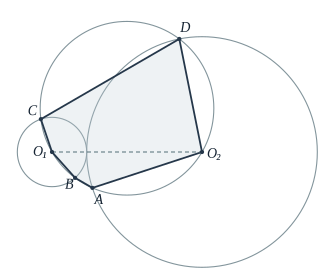
Show answer and methods 2 methods
Answer
140
Method 1 Compare the circumradii on opposite sides of the shared diagonal
Let the two radii be , so , and set . Cutting along gives cyclic quadrilaterals with consecutive sides , where equals or . For a quadrilateral of sides in cyclic order, area and circumradius , one has . Indeed the diagonal opposite the angle between satisfies by the cosine rule at supplementary opposite angles. Also and .
Brahmagupta’s formula , with the semiperimeter, gives and . In the radius formula the numerator becomes on using .
The two expressions for are equal, so . Clearing the denominators and factoring gives . Positivity forces .
The areas are now and . Their sum is .
Method 2 Pair opposite chord half-angles
In boundary order let the six half-arc angles be , so for . Repeated angles come from equal radius chords; complementary half-angles for equal chords cannot occur, as the remaining arcs would have no room. Put , , the common circumradius. Then , , and .
Since , summing the first two chord lengths gives , hence . Multiplying them gives .
Using and gives , so . The two cyclic quadrilaterals with common side have semiperimeters ; Brahmagupta’s formula gives areas and . Their sum is .
Source and attribution
The outline and worked methods on this page were prepared for DR.WANG Mathematics.
Original question (external)